Why Vinyl Gutters Fail in South Georgia Heat — And What to Replace Them With
Vinyl gutters are the cheapest gutter option at every home improvement store in the Valdosta area, and they are the worst choice for any home in South Georgia. The material fails under the specific combination of conditions that define this region’s climate — sustained summer heat that warps the PVC compound, intense UV radiation that makes it brittle, and temperature cycling that loosens the friction-fit connectors that hold sectional vinyl systems together.
Homeowners who install vinyl gutters as a DIY cost-saving project typically replace them within three to five years. The total cost of the vinyl system plus its removal plus the professional aluminum system that replaces it exceeds what the aluminum system alone would have cost from the start. Vinyl gutters in South Georgia are not a budget option — they are a delayed expense with a wasted intermediate step.
How Heat Destroys Vinyl Gutters
PVC — polyvinyl chloride — is the base material in vinyl gutters. Standard PVC begins to soften at approximately 120 to 140 degrees Fahrenheit, depending on the specific formulation and any heat-stabilizing additives in the compound.
South Georgia summer conditions routinely push vinyl gutters past this softening threshold. The mechanism is straightforward. Dark-colored roofing materials — asphalt shingles in black, dark brown, charcoal, or weathered wood tones — absorb solar radiation and heat the roof surface to 140 to 170 degrees on summer afternoons. The gutter, mounted at the roof edge, absorbs radiant heat from the roof surface on its back side and direct solar radiation on its front and top surfaces.
A vinyl gutter at the edge of a dark roof on a July afternoon in Valdosta reaches temperatures well above the PVC softening point. The material does not melt — it softens. The trough develops a slight flex where the material deforms under the combined weight of any standing water or debris and its own structural weight.
Each afternoon softening cycle introduces a small amount of permanent deformation. Over a full summer — approximately 90 days of temperatures exceeding 95 degrees, with roof-surface temperatures routinely exceeding 150 degrees — the cumulative deformation creates visible sag between mounting brackets. The sag creates low spots. Low spots hold standing water. Standing water adds weight that accelerates sag during the next softening cycle.
By the end of the second summer, a vinyl gutter in direct sun on a dark-roofed South Georgia home has developed permanent low spots that hold water continuously and no longer drain properly to the downspouts. By the third summer, the profile has distorted enough that the gutter is functionally failed — water sheets over the deformed front edge during any moderate rainfall.
How UV Destroys Vinyl Gutters
UV radiation breaks the long polymer chains in PVC through a process called photodegradation. The UV energy breaks carbon-carbon bonds in the polymer backbone, creating shorter molecular fragments that no longer have the flexibility and impact resistance of the original material.
The visible evidence of UV degradation is color change and surface chalking. White vinyl yellows. Brown vinyl fades to a chalky gray. The surface develops a powdery texture that rubs off on contact. These cosmetic changes indicate that the molecular structure of the material has fundamentally changed from flexible to brittle.
Brittle vinyl cracks under stress that new material would absorb elastically. A branch falling onto a UV-degraded vinyl gutter can crack or shatter the section on impact. Placing a ladder against a sun-exposed vinyl gutter — a necessary action for any maintenance or repair — can crack the front lip. Even the weight of a heavy pine needle accumulation after a few months without cleaning can crack a UV-degraded trough bottom.
In South Georgia, where direct sun exposure is intense for eight to ten months per year and the UV index regularly exceeds 8 during summer, photodegradation reaches the brittle-failure threshold within two to four years on south-facing and west-facing gutter sections. North-facing sections degrade more slowly but still reach the failure point within four to six years.
Why Vinyl Is Only Available as Sectional
Seamless gutter fabrication uses a portable roll-forming machine that bends flat metal coil through a series of rollers to create the gutter profile. This process requires a material that is ductile — capable of being permanently deformed by bending without breaking.
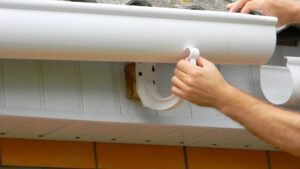
PVC is not ductile at the dimensions used for gutter profiles. It cannot be roll-formed on-site. Vinyl gutters are manufactured in factories as pre-cut 10-foot sectional pieces that are joined on-site with snap-together friction-fit connectors.
These connectors are the weakest element in the system. Unlike metal sectional gutters, which use rivets and sealant to create joints that resist movement, vinyl connectors rely on friction — the slight compression of the connector against the inside walls of the gutter. Temperature cycling causes the PVC to expand and contract at every joint, gradually loosening the friction fit over dozens of heating-cooling cycles.
Loose connectors leak. Unlike a metal joint where re-sealing with caulk or silicone provides a durable repair, a loosened vinyl connector cannot be permanently tightened. The material returns to its expanded state with every subsequent heat cycle, re-opening the gap. The only repair for a loose vinyl connector is replacement of the connector and reseating of both sections — which works until the next cycle of temperature changes loosens it again.
What to Replace
Vinyl Gutters With
The replacement material is 6-inch seamless aluminum in 0.032 gauge — the standard specification for every residential installation in South Georgia. The installed cost of $6 to $10 per linear foot replaces a vinyl system that cost $3 to $5 per linear foot for materials alone, plus the homeowner’s time for DIY installation.
The total cost of the conversion — vinyl removal, fascia inspection, new aluminum fabrication and installation — runs $7 to $13 per linear foot on a typical home, or $1,225 to $2,275 for 175 linear feet. This is a one-time expense that provides 20 to 30 years of service, versus the vinyl system that would need replacement every three to five years at $525 to $875 each time (materials only, not counting the homeowner’s time).
Over a 20-year period, the single aluminum installation costs less than four vinyl replacement cycles and delivers dramatically better performance in every metric — water capacity, leak resistance, debris management, wind resistance, and appearance.
Frequently Asked Questions