
Home What Happens If You Never Clean Your Gutters? Gutters are designed to collect rainwater from your roof and direct...
Read More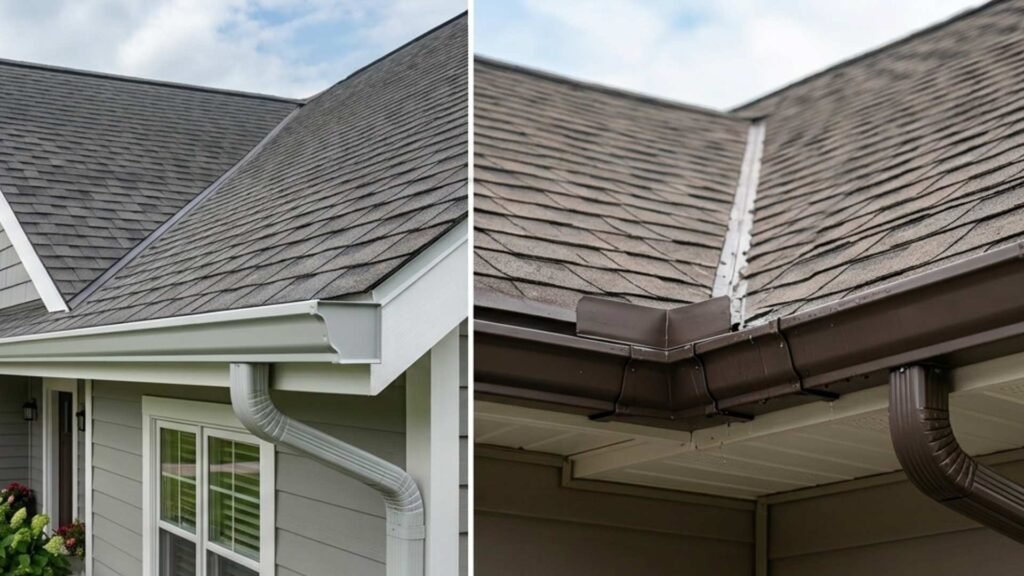
Seamless vs Sectional Gutters — Which Is the Right Choice for South Georgia Homes?
Seamless gutters outperform sectional gutters in every category that matters in South Georgia — leak resistance, debris management, longevity, and appearance. The cost difference between the two is negligible for professional installation, making seamless the clear choice for Valdosta, Hahira, Lake Park, and surrounding communities where climate conditions accelerate every weakness that sectional systems have.
The distinction is straightforward. Sectional gutters come in pre-cut 10-foot lengths joined by connectors at every seam. Seamless gutters are fabricated from continuous aluminum coil on-site, producing one unbroken piece per run with joints only at corners and downspout outlets. A typical home has 4 to 8 joints in a seamless system versus 20 to 30 in a sectional system. Every joint is a potential failure point, and in South Georgia’s demanding climate, potential failures become actual failures faster than anywhere else in the Southeast.
Leak Resistance — The Primary Advantage
Every joint in a sectional gutter is sealed with butyl or silicone caulk during installation. That caulk is the only thing preventing water from bypassing the gutter at each connection point. Under normal conditions in a moderate climate, caulk sealant lasts five to seven years before degrading enough to allow seepage.
Valdosta is not a moderate climate for caulk. Summer roof-surface temperatures regularly exceed 150 degrees on dark-colored roofing materials, and the gutter sits directly at the roof edge absorbing that radiant heat. The temperature cycling between 150-degree summer peaks and occasional winter lows in the low 30s causes the aluminum to expand and contract at each joint. The caulk, which is less elastic than the metal, cracks under this repeated flexing. Once a hairline crack develops, water wicks through it during every rain event.
The consequences of a single leaking joint in South Georgia are disproportionate to the size of the leak. A joint that drips during rain deposits water directly behind the gutter and onto the fascia board. In a dry climate, the fascia dries between rain events and the damage is slow. In Valdosta, where humidity stays above 70 percent year-round and summer rain comes multiple times per week, the fascia never fully dries. Wood rot fungi activate and spread. Within one to two seasons of a joint beginning to leak, the fascia behind it is soft enough to fail — and the gutter hanger screwed into that fascia loses its holding power, causing the gutter to sag.
One leaking joint can cause $500 to $1,500 in fascia damage if left for two years. A sectional system with 20 to 30 joints has 20 to 30 potential leak sources. Seamless systems eliminate this problem at its source by reducing the joint count by 75 to 85 percent.
Debris Performance in Pine Environments
This is where the difference matters most for South Georgia homeowners. Pine needles interact with sectional gutter joints in a way that leaves do not.
The raised edges of sectional connectors create small speed bumps inside the gutter trough. During rain, water carries loose pine needles toward the downspout. When a needle hits the raised connector edge, it catches and stops. Other needles pile behind it. Within a few rain events, a small dam forms at the joint. The dam grows with each subsequent rainfall as more needles pack against it.
Once the dam reaches the height of the water flow — typically after three to four weeks of accumulation in heavy-pine areas — water backs up behind it and overflows at the front edge of the gutter. The homeowner sees overflow and assumes the gutter needs cleaning, but the root cause is a structural feature of the sectional system that cleaning only temporarily resolves. The dam reforms at the same joint within weeks because the raised connector edge is still there.
Seamless gutters have a smooth, uninterrupted interior channel. Pine needles that enter the gutter trough during rain slide along the smooth surface toward the downspout rather than catching on connector edges. This doesn’t eliminate the need for cleaning — needles still accumulate at low points and at downspout openings — but it reduces the rate of blockage by approximately 30 percent compared to sectional systems.
For Valdosta homeowners already cleaning three times per year, that 30 percent improvement extends the functional window between cleanings enough to prevent the mid-cycle overflow that causes water damage. In practical terms, a seamless system stays functional through the full interval between scheduled cleanings, while a sectional system in the same pine environment may overflow at week six of a twelve-week interval.
Cost Comparison — Closer Than You Think
The common assumption is that seamless gutters cost significantly more than sectional. For DIY installation, this is true — sectional gutters can be purchased at a home improvement store for $1.50 to $3.00 per linear foot and installed by a homeowner with a ladder and a caulk gun. Seamless gutters require a portable roll-forming machine and professional installation, so there is no DIY option.
For professional installation, the cost difference largely disappears. Sectional systems require more labor at each joint — aligning the connector, applying sealant, securing with rivets or screws, and verifying the seal. A 175-foot home with 20 to 25 joints takes the same total labor hours to install as a seamless system with 4 to 8 joints, because the per-joint work offsets the continuous fabrication time.
| Factor | Seamless | Sectional |
|---|---|---|
| Material Cost Per Foot | $2 – $4 | $1.50 – $3 |
| Installation Labor Per Foot | $3 – $6 | $3.50 – $7 |
| Total Installed Cost Per Foot | $6 – $10 | $5 – $10 |
| Joints on Typical Home | 4 – 8 | 20 – 30 |
| Cleaning Frequency (Valdosta) | 3x/year | 3x/year (Clogs Faster) |
| Average Repair Cost (10 Years) | $200 – $400 | $500 – $1,200 |
| Expected Lifespan (South GA) | 20 – 30 Years | 10 – 15 Years |
The total installed cost ranges overlap significantly. A professionally installed seamless system and a professionally installed sectional system on the same home often fall within $100 to $300 of each other. The meaningful cost difference is not in the installation — it is in the maintenance and repair trajectory over the system’s lifespan.
Lifetime Cost — Where Seamless Wins Decisively
Over a 20-year period, a seamless system installed on a Valdosta home costs less to own than a sectional system because maintenance and repair costs are substantially lower.
A seamless system needs standard cleaning three times per year ($300 to $450 annually) and occasional minor repairs — perhaps one or two splice repairs over 20 years if a section is damaged by a falling limb ($150 to $400 per repair). Total 20-year maintenance cost: approximately $7,000 to $10,000.
A sectional system needs the same cleaning frequency but develops joint leaks that require resealing every three to five years ($75 to $150 per joint, with multiple joints failing in each cycle). Joint failures also cause fascia rot that requires repair ($400 to $1,200 per incident). And the system itself needs replacement at 10 to 15 years rather than 20 to 30, meaning the homeowner pays for installation twice in the same period. Total 20-year cost including one replacement: approximately $10,000 to $18,000.
The seamless system that costs $50 to $300 more at installation saves $3,000 to $8,000 over 20 years. The math is not close.
The One Scenario Where Sectional Makes Sense
Sectional gutters make financial sense in exactly one scenario: the homeowner needs a temporary solution for a property they plan to sell or demolish within three to five years and wants to minimize upfront cost with a DIY installation. The short time horizon means the joint degradation, accelerated clogging, and fascia damage won’t have time to accumulate to expensive levels.
In every other scenario — owner-occupied homes, rental properties held long-term, any home where the owner plans to stay more than five years — seamless is the better investment by a wide margin.
Frequently Asked Questions
Can I replace sectional gutters with seamless?
The old sectional system is removed, the fascia is inspected and repaired if needed, and a new seamless system is fabricated and installed on-site. This is the most common type of gutter replacement project in the Valdosta area. Most conversions take one to two days.
Are seamless gutters available in the same colors as sectional?
Seamless gutters are available in over 20 factory-baked enamel colors — a wider selection than most sectional gutter lines at home improvement stores. The finish is baked onto the coil before fabrication and will not peel, chip, or fade for 20 years or more.
Can a section of seamless gutter be repaired if damaged?
Individual sections can be cut out and spliced with new seamless material using a slip joint connector. The repair introduces one or two joints — still far fewer than a full sectional system. Most seamless gutter repairs in Valdosta cost $150 to $400.
Do both types work with gutter guards?
Both seamless and sectional gutters are compatible with gutter guard systems. However, gutter guards perform better on seamless gutters because the smooth interior channel allows debris to move toward the downspout more effectively, and guards mounted on seamless gutters sit more flush because there are no connector ridges disrupting the surface.
Which lasts longer in South Georgia's climate?
Seamless gutters last 20 to 30 years in South Georgia with 0.032-gauge aluminum. Sectional systems typically need joint repair or full replacement within 10 to 15 years due to caulk degradation, connector loosening, and accelerated corrosion at joint points from temperature cycling and humidity.
Is DIY sectional installation worth it in Valdosta?
DIY sectional installation saves on labor cost but carries specific risks in Valdosta. Sandy soil makes ladder footing unstable, improper slope causes pooling and corrosion, and improperly sealed joints leak from the first rain event. The labor savings from DIY installation are typically consumed by repair costs and premature replacement within three to five years.
Recent Posts
Gutter Installation Mistakes Homeowners Should Avoid
Home Gutter Installation Mistakes Homeowners Should Avoid A new gutter system is supposed to make it easier to control rainwater...
Read More
What Happens When Gutters Are Too Small for Your Roof?
Home What Happens When Gutters Are Too Small for Your Roof? Your gutters need to handle the amount of rainwater...
Read More
How to Tell if Your Gutters Are Properly Installed
Home How to Tell if Your Gutters Are Properly Installed A gutter system can look perfectly fine from the ground...
Read More
Do You Need Gutters on Every Side of Your House?
Home Do You Need Gutters on Every Side of Your House? Not every home necessarily needs gutters on every side...
Read More
How Long Do Gutters Last in Georgia?
Home How Long Do Gutters Last in Georgia? Gutters are an important part of a home’s exterior drainage system. They...
Read More
How to Choose the Right Gutters for Your Valdosta Home
Home How to Choose the Right Gutters for Your Valdosta Home Choosing gutters for your home is about more than...
Read More
Signs Your Gutters Are Clogged: What Valdosta Homeowners Should Look For
Home Signs Your Gutters Are Clogged: What Valdosta Homeowners Should Look For Gutters are designed to collect rainwater from your...
Read More
How Much Does Gutter Cleaning Cost in Valdosta, GA?
Home How Much Does Gutter Cleaning Cost in Valdosta, GA? If your gutters are filled with leaves, pine needles, dirt,...
Read More
Seamless Gutters vs. Regular Gutters: Which Is Better for Your Valdosta Home?
Home Seamless Gutters vs. Regular Gutters: Which Is Better for Your Valdosta Home? If you are planning a new gutter...
Read More